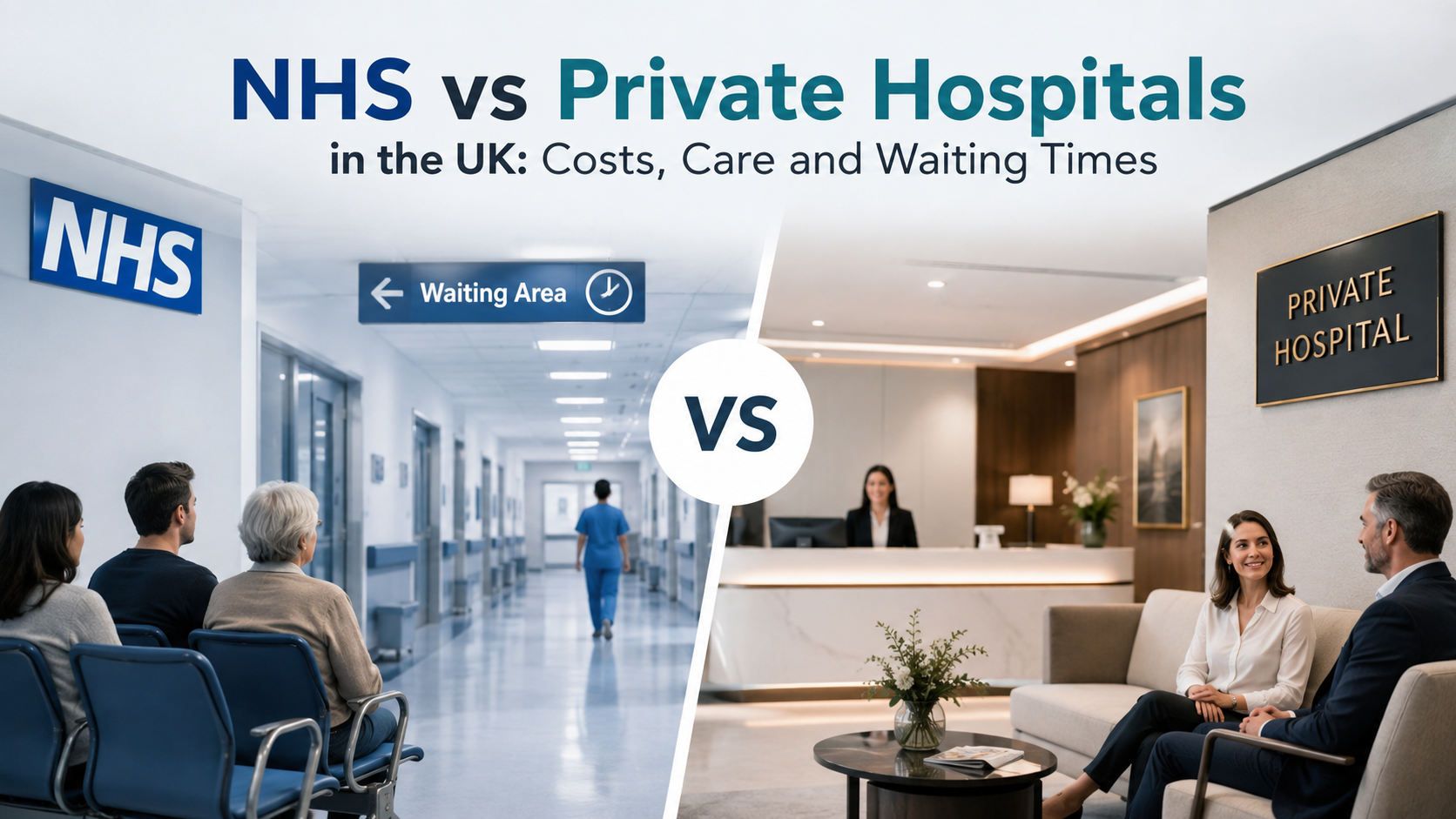
Choosing between NHS and private hospital care in the UK is rarely as simple as deciding which system provides “better” treatment. Both use regulated healthcare professionals, and many consultants work across both NHS and independent hospitals. The main differences usually involve how treatment is funded, how quickly patients can access planned care, how much choice they have over consultants and appointment dates, and what services are available at a particular hospital.
For people who are ordinarily entitled to NHS care, medically necessary hospital treatment is generally provided without a bill at the point of treatment. Private care, by contrast, must normally be funded through private medical insurance, an employer healthcare scheme or direct self-payment. That additional cost may provide faster access to some elective services and greater scheduling flexibility, but it does not automatically mean better clinical outcomes.
This article explains NHS vs private hospitals in the UK from a practical patient perspective. It covers costs, waiting times, quality and safety, specialist referrals, private medical insurance, emergency treatment, patient choice and the possibility of using NHS and private services at different stages of the same healthcare journey. Because NHS rules differ across England, Scotland, Wales and Northern Ireland, readers should confirm local arrangements before making financial or medical decisions.
NHS and Private Healthcare in the UK: The Basic Difference
The National Health Service provides the majority of healthcare in the UK. However, there is not technically one identical NHS operating nationwide. England, Scotland, Wales and Northern Ireland each manage their own health services, with differences in referral policies, waiting-time frameworks, prescription arrangements and patient-choice rules.
The basic principle is similar across the four nations: eligible patients can receive a wide range of medically necessary healthcare without paying the full cost directly at the time of treatment. The NHS is primarily funded through taxation.
Private healthcare operates alongside the NHS. Patients can purchase individual treatments themselves or obtain care through private medical insurance. Independent hospitals may be operated by commercial companies, charities or specialist healthcare organisations.
Private hospitals commonly provide services such as:
- Consultant outpatient appointments
- Diagnostic imaging and investigations
- Orthopaedic surgery
- Ophthalmology
- Gynaecology
- General surgery
- Cardiology investigations and treatment
- Cancer diagnostics and selected cancer treatments
- Physiotherapy and rehabilitation
- Health screening
The scope varies substantially between hospitals. Large independent hospitals may have intensive-care facilities, complex surgical programmes and extensive diagnostic departments, while smaller facilities may concentrate primarily on planned day-case surgery and outpatient treatment.
NHS vs Private Hospitals: Quick Comparison
| Factor | NHS Hospital | Private Hospital |
|---|---|---|
| Funding | Mainly publicly funded through taxation | Self-pay, private medical insurance or employer healthcare scheme |
| Cost to eligible patient | Most medically necessary hospital care has no direct charge at the point of use | Patient or insurer normally pays for treatment |
| Emergency care | Major provider of emergency and trauma services | Most private hospitals are focused on planned rather than emergency care |
| Planned-treatment waiting time | Can vary considerably by specialty, hospital and region | Often faster for elective consultations and procedures, but no universal guarantee |
| Consultant choice | Choice exists in some circumstances, particularly within NHS England, but rules apply | Patients can often select a particular consultant, subject to availability and insurance rules |
| Appointment flexibility | Depends on NHS capacity | Often greater flexibility for appointment and surgery dates |
| Clinical standards | Regulated healthcare environment | Regulated healthcare environment |
| Room amenities | Usually based on clinical need and available NHS facilities | Private rooms and additional non-clinical amenities are more common |
| Complex or highly specialised care | Major NHS teaching and specialist centres provide extensive complex services | Available in some private centres, but capability varies substantially |
The comparison should not be interpreted as a ranking. The appropriate setting depends on the condition, urgency, clinical expertise required, local hospital capability, insurance position and the patient’s priorities.
How Much Does NHS Hospital Treatment Cost?
For patients entitled to NHS treatment, most hospital services are provided without direct charges at the point of care. This includes many consultations, diagnostic tests, operations and inpatient services provided as NHS treatment.
That does not mean every healthcare service in the UK is automatically free for every person. Rules concerning eligibility and charges can depend on where a person normally lives, immigration or residency circumstances, the part of the UK providing treatment and the type of healthcare involved.
Some services outside hospital care can also involve patient charges. Prescription, dental and optical charging arrangements differ across the four UK nations.
Visitors and People Moving to the UK
International visitors should not assume that simply being physically present in Britain gives them free access to all NHS hospital treatment.
Rules for overseas visitors are more complicated. Certain services are exempt from charges, while other hospital care may be chargeable depending on residency and eligibility.
In England, official guidance on using NHS services when visiting or moving to England explains the general arrangements. Anyone travelling specifically for treatment should obtain individual guidance rather than relying on general descriptions of free NHS healthcare.
How Much Does a Private Hospital Cost in the UK?
There is no reliable single price for private hospital treatment across the UK. Private medical bills depend on far more than the name of the operation.
A patient’s total price may depend on the hospital, consultant, anaesthetist, diagnosis, complexity of treatment, diagnostic investigations, medicines, implants, length of stay and whether complications require additional care.
Private treatment can be financed in three main ways: self-payment, private medical insurance or an employer-sponsored healthcare plan.
Self-Pay Private Treatment
Self-pay patients fund care directly rather than making an insurance claim. Some independent hospitals offer packaged prices for certain routine procedures. A package may combine several elements of treatment, but patients should never assume everything is included.
Before agreeing to treatment, request a written estimate showing:
- The hospital or facility fee
- Consultant fees
- Anaesthetist fees where relevant
- Diagnostic tests and imaging
- Implants or medical devices
- Medicines
- Physiotherapy or rehabilitation
- Follow-up consultations
- What happens financially if treatment becomes more complicated than expected
A quoted starting price should not automatically be treated as the final amount payable.
Why This Article Does Not Give a Single National Price List
Private prices can change and hospitals frequently price different procedures differently. Consultant fees may also be separate from hospital charges.
Publishing a supposedly universal figure for a hip replacement, MRI scan, cataract operation or other procedure can therefore be misleading unless the figure comes from a clearly identified provider and specifies exactly what is included.
The UK’s Private Healthcare Information Network (PHIN) publishes information designed to help patients research private consultants and hospitals. Patients should also request current written quotations directly from providers.
| Private Service | How Pricing Usually Works | Questions to Ask |
|---|---|---|
| Consultant appointment | May be charged separately by the consultant | Does the fee include follow-up? |
| MRI, CT or other imaging | Depends on scan type, body area, contrast and reporting arrangements | Are radiologist reporting fees included? |
| Day-case surgery | May be available as a treatment package | Are surgeon, anaesthetist and hospital fees all included? |
| Inpatient surgery | Depends heavily on complexity and length of stay | What happens if an additional night is required? |
| Rehabilitation | May be separate from surgical costs | How many physiotherapy sessions are included? |
NHS vs Private Waiting Times
Waiting time is one of the main reasons people investigate private healthcare.
NHS waiting periods depend on the specialty, urgency of the patient’s condition, hospital capacity, local demand and available staff. Emergency and clinically urgent patients are prioritised differently from people waiting for routine elective procedures.
England’s NHS publishes detailed referral-to-treatment waiting-time statistics. These datasets are useful for understanding system performance, but national figures cannot predict exactly how long one individual will wait.
A patient waiting for dermatology in one region may have a completely different experience from someone waiting for orthopaedic surgery elsewhere.
The 18-Week NHS Standard in England
The NHS Constitution for England includes rights and pledges relating to waiting times for consultant-led treatment. The often-referenced 18-week referral-to-treatment framework should be understood as a healthcare standard rather than a promise that every patient in every circumstance will actually receive treatment within exactly 18 weeks.
Current performance against NHS standards changes over time. Readers can review the NHS Constitution for England and NHS England’s current statistical releases for the latest position.
Are Private Hospital Waiting Times Always Shorter?
Private appointments for routine elective care are often available sooner, which is a major reason patients pay privately. But private treatment is not instant and there is no single nationwide private-sector waiting-time guarantee.
Availability depends on the consultant, hospital, procedure and clinical circumstances.
A highly sought-after specialist may have a waiting list even privately. Complex surgery may require operating-theatre availability, specialist equipment, an intensive-care bed or coordination between several consultants.
Private treatment should therefore be compared using an actual appointment or procedure date rather than assuming that every private provider can treat immediately.
Is Private Healthcare Better Than the NHS?
Private care is not inherently clinically superior to NHS care.
Many doctors work in both sectors. An NHS consultant may, for example, perform NHS operations during part of the week and see private patients during separate contracted sessions.
The clinical question is therefore not simply “NHS doctor or private doctor?” A better comparison considers the particular clinician, multidisciplinary team, hospital facilities, volume and type of work performed, diagnostic capability, aftercare arrangements and ability to manage complications.
Areas Where Private Care May Offer Advantages
The benefits most commonly associated with private treatment relate to access and convenience rather than a guarantee of superior medicine.
Depending on the provider, private patients may receive greater flexibility when choosing a consultant, shorter waits for elective consultations, greater control over appointment dates, more private accommodation and easier access to some diagnostic tests.
Areas Where the NHS Has Major Strengths
The NHS has an extensive national infrastructure that includes major trauma centres, emergency departments, highly specialised services, teaching hospitals, neonatal and paediatric intensive care, transplantation programmes and management of patients with multiple complex conditions.
For medical emergencies, the NHS is the central healthcare system. Most independent hospitals are designed mainly for scheduled treatment and are not substitutes for NHS emergency departments.
Emergency Care: NHS or Private?
A person experiencing a serious medical emergency should not delay urgent assessment while comparing private hospital prices or insurance benefits.
In the UK, NHS emergency services provide the main infrastructure for accident and emergency care. Some private hospitals have urgent-care facilities, but their capabilities vary and many do not operate full emergency departments comparable with major NHS hospitals.
Call 999 for a life-threatening emergency.
For less immediately life-threatening problems in England, NHS 111 can help direct patients toward appropriate services. Equivalent local NHS pathways operate elsewhere in the UK.
Quality and Safety in NHS and Private Hospitals
Payment method alone is not a reliable measure of hospital quality.
In England, both NHS and independent healthcare providers fall within the regulatory framework overseen by the Care Quality Commission (CQC) for services within its remit.
Scotland, Wales and Northern Ireland have their own regulatory and inspection arrangements.
Patients considering a hospital should look beyond its rooms, food or marketing materials. Useful questions include how the service manages infection prevention, consultant cover, deterioration after surgery, intensive-care needs and transfers if complications arise.
Private Healthcare Information Network
For private hospital care, PHIN provides information intended to improve transparency about hospitals and consultants. Depending on available data, patients may be able to research aspects such as consultant practice and private healthcare activity.
PHIN developed from measures introduced following the Competition and Markets Authority’s investigation into private healthcare. It can be a useful starting point, but it should be used alongside regulatory information and a discussion with the treating clinician.
Private Medical Insurance vs Paying Yourself
Buying private medical insurance does not mean every private healthcare bill will automatically be covered.
Policies differ substantially. A plan may have restrictions involving pre-existing medical conditions, chronic disease, specific treatments, approved hospitals, consultant fee limits, outpatient benefits or required authorisation.
Common Private Insurance Terms
| Term | What It Generally Means |
|---|---|
| Excess | The amount the patient may need to contribute before or toward an eligible claim, depending on the policy |
| Pre-authorisation | Approval obtained from the insurer before specified treatment takes place |
| Hospital network | The group or list of hospitals available under a particular policy |
| Consultant fee limit | The amount an insurer is prepared to reimburse for certain professional fees under its rules |
| Exclusion | A condition, service or circumstance that the policy does not cover |
| Outpatient cover | Benefits relating to eligible consultations, tests or treatment where admission is not required |
Terminology and contractual definitions vary between insurers. The policy wording, membership certificate and insurer’s confirmation should take priority over a general explanation online.
Five Things to Confirm Before Private Treatment
- Is the medical condition eligible under the policy?
- Is the hospital included within the patient’s hospital network?
- Is the selected consultant recognised for the proposed treatment?
- Has any required pre-authorisation been issued?
- Could the patient owe an excess, fee shortfall or non-covered charge?
Patients should obtain authorisation before treatment whenever their insurer requires it. A hospital saying that it regularly treats patients insured by a particular company is not the same as confirmation that one person’s individual treatment will be covered.
Can You Have a Private Consultation and NHS Treatment?
Patients sometimes pay for a faster private specialist consultation but then want any required operation performed through the NHS.
This can be possible, but paying for a private consultation does not normally allow someone to purchase a better position on an NHS waiting list. NHS treatment must still follow NHS clinical-priority, eligibility and referral arrangements.
The consultant may provide information or recommendations that can be shared with the patient’s GP and NHS team. The NHS service will decide what treatment is clinically appropriate within its own processes.
Can You Mix NHS and Private Treatment?
Patients are not generally required to abandon NHS healthcare merely because they purchase separate private treatment. However, the NHS and privately funded elements should be clearly separated.
Official Department of Health and Social Care guidance addresses circumstances where NHS patients wish to purchase additional private care.
The exact practical arrangements depend on the treatment. Patients contemplating a mixture of NHS and private services should clarify which provider is responsible for investigations, prescriptions, follow-up, complications and ongoing monitoring.
Avoid Assuming the NHS Will Automatically Cover Private Aftercare
If surgery is performed privately, patients should ask the private hospital what routine postoperative care is included.
Questions should cover wound checks, physiotherapy, medication, investigations and treatment of complications. NHS clinicians will provide clinically necessary NHS care where appropriate, but patients should not structure a private treatment package around an assumption that routine private aftercare can simply be transferred to the NHS.
Choosing Your Hospital and Consultant
Private patients usually have substantial freedom to research consultants and hospitals, although insurance networks can limit the options available.
Choice also exists within parts of the NHS, but the rules are different. England has patient-choice arrangements covering certain referrals for planned care. Scotland, Wales and Northern Ireland operate under their own frameworks.
NHS patients in England can review official information on choices available within the NHS.
Compare Clinical Capability, Not Hotel Features
Private rooms, flexible visiting arrangements and food options may matter to a patient, but they should not outweigh clinical considerations.
For significant surgery, ask whether the hospital routinely provides the required procedure, what level of critical-care support is available and how an unexpected deterioration would be managed.
Some patients with significant medical complexity may be better treated in a centre where all required specialists and critical-care services are immediately available. That decision should be made with the clinicians responsible for treatment.
Questions to Ask a Consultant
- Why is this treatment being recommended?
- Are there reasonable alternatives?
- What are the important risks and expected benefits?
- Where will the procedure take place?
- Who will provide follow-up care?
- What happens if complications occur?
- Which parts of the treatment generate separate fees?
For major procedures, patients may also want to confirm the consultant’s registration and specialist status through the General Medical Council medical register.
NHS vs Private Care for Common Types of Treatment
Orthopaedic Surgery
Joint replacement and other elective orthopaedic procedures are common reasons people consider private treatment because the underlying problem can cause pain and impaired mobility while the patient waits.
Private access may provide a quicker consultation or surgical date. The relevant comparison should include the surgeon’s expertise, implant strategy, anaesthetic assessment, rehabilitation programme, medical complexity and management of surgical complications.
Cataract Surgery
Cataract treatment is available through the NHS when clinically appropriate, while private ophthalmology provides an alternative for people wanting different timing or privately offered options.
Patients should understand exactly what lens and procedure are being proposed rather than deciding solely on waiting time or advertising claims.
Cancer Care
Cancer treatment requires a more nuanced comparison. The NHS provides extensive cancer diagnostics, multidisciplinary teams, surgery, radiotherapy and systemic treatments. Private cancer services are also available, often through insurance or self-payment.
The treatment decision should consider the specific cancer, appropriate specialist team, diagnostic pathway and availability of clinically indicated treatment. A faster appointment alone does not determine which treatment plan is medically appropriate.
Diagnostic Imaging
Private MRI, ultrasound and other diagnostic services are sometimes used by patients seeking faster investigation.
Before purchasing a scan independently, establish who will interpret the result and who will take responsibility for deciding what happens next. Diagnostic testing without appropriate clinical follow-up can create additional uncertainty rather than solve it.
Does Paying Privately Help You Get Faster NHS Care?
Private payment should not be viewed as a method for buying priority inside an NHS treatment pathway.
If a private investigation identifies a condition that requires NHS treatment, the NHS team can consider the clinically relevant information. However, subsequent NHS decisions should be based on clinical need and applicable NHS processes.
Patients considering private diagnostic testing because of an NHS delay should ask beforehand whether the relevant NHS team will accept external imaging or test results and whether the test meets the required technical standards. Repeating an investigation may occasionally be necessary.
What Happens If Something Goes Wrong in a Private Hospital?
Before private treatment, patients should understand the hospital’s escalation arrangements.
Large private hospitals may have substantial critical-care facilities, but capabilities vary. Some independent facilities may transfer a seriously unwell patient to an NHS hospital if a level of emergency or specialist care is needed that is not available on site.
That possibility does not in itself mean the private hospital is unsafe. Different hospitals are designed for different levels of complexity. What matters is that the treatment location is appropriate for the patient’s needs and has a clear plan for emergencies.
Ask the hospital:
- What level of critical care is available?
- Is medical cover available overnight?
- How are surgical complications managed?
- Under what circumstances would a patient be transferred?
- Who pays for additional private treatment resulting from complications?
Advantages and Disadvantages of NHS Hospitals
Potential Advantages
The major financial advantage is straightforward: eligible patients generally do not receive a private-style hospital bill for medically necessary NHS care. The system also provides extensive emergency medicine, highly specialised services and care for people with complicated or multiple health conditions.
NHS teaching and tertiary centres can provide levels of specialist expertise and multidisciplinary support that are difficult to replicate in every independent hospital.
Potential Disadvantages
The main concern for many patients is access to non-urgent treatment. Waiting periods can be substantial in some specialties and locations.
Patients may also have less control over appointment timing, the precise date of an operation or the individual consultant providing every stage of care. The experience varies widely between services.
Advantages and Disadvantages of Private Hospitals
Potential Advantages
Private treatment may provide faster access to elective consultations, diagnostics and procedures. Patients can often choose a named specialist and schedule appointments with greater flexibility.
Private accommodation and additional non-clinical amenities may also appeal to some people.
Potential Disadvantages
Cost is the clearest disadvantage. A patient paying personally can face several separate charges, while an insured patient may still face exclusions, excesses or shortfalls.
Private hospitals also differ substantially in clinical capability. A facility that is well designed for uncomplicated planned surgery may not provide the same range of intensive-care, emergency or multidisciplinary services as a major NHS teaching hospital.
How to Decide Between NHS and Private Treatment
Rather than asking which entire healthcare system is better, compare the actual pathway available for your condition.
| Question | Why It Matters |
|---|---|
| How urgent is the condition? | Clinical urgency should guide the pathway before convenience |
| What is the realistic NHS waiting time locally? | National averages may not describe the relevant hospital |
| How soon can the private provider actually treat? | Private treatment is not always immediate |
| What is the total private cost? | Consultant, hospital and follow-up fees may differ |
| Does insurance cover the treatment? | Coverage depends on the individual policy and authorisation |
| Does the hospital have the required facilities? | Complex conditions can require multidisciplinary and critical-care support |
| Who manages follow-up? | Clear responsibility reduces gaps after treatment |
When NHS Care May Be the More Practical Choice
NHS care may make particular sense where treatment is urgent, highly complex, available within an acceptable timeframe or would create substantial financial pressure if purchased privately.
It may also be preferable when several medical specialties need to coordinate treatment within a large tertiary hospital.
When Private Care May Be Worth Investigating
Private treatment may be worth researching when a patient faces a long wait for non-emergency care, wants a particular consultant or appointment schedule, has appropriate insurance or can comfortably afford the complete self-pay pathway.
The financial decision should include follow-up and potential additional costs, not only the advertised price of the procedure.
Frequently Asked Questions
Is private healthcare better than the NHS in the UK?
Not automatically. Private healthcare can offer faster access to some elective services, increased consultant choice and more convenient scheduling. The NHS has major strengths in emergency medicine, complex care and highly specialised services. Many consultants work in both systems. For an individual patient, the relevant comparison is the expertise and facilities required for the condition, the realistic waiting time and the complete cost rather than whether the hospital is labelled NHS or private.
Is NHS hospital treatment completely free?
Most medically necessary NHS hospital treatment is provided without a direct charge at the point of use for people entitled to NHS care. However, eligibility rules matter, particularly for visitors and people who have recently moved to the UK. Charges can also apply to some healthcare services outside ordinary NHS hospital treatment, with arrangements differing between England, Scotland, Wales and Northern Ireland.
How much does a private hospital cost in the UK?
There is no single UK private-hospital price. Costs depend on the procedure, consultant, hospital, investigations, anaesthesia, implants, medicines, length of stay and follow-up care. Some hospitals offer packaged self-pay prices for selected procedures. Patients should obtain a written quotation and confirm exactly what is included rather than relying on a nationwide “average” that may not reflect their treatment.
Are private hospital waiting times shorter than NHS waiting times?
They frequently can be for planned consultations, investigations and elective procedures, but this is not guaranteed. Private availability depends on the specialist, hospital and treatment. NHS waits also vary substantially between services and locations. The most useful comparison is to ask the NHS provider about the expected local pathway and obtain an actual appointment or treatment date from the private provider.
Can I pay privately while remaining an NHS patient?
Buying separate private healthcare does not generally mean giving up entitlement to NHS care. However, private and NHS treatment must be managed appropriately and there are rules about how additional private care is separated from NHS-funded services. Patients combining the two should clarify who is responsible for tests, medicines, follow-up and complications.
Can I see a consultant privately and then have surgery on the NHS?
Potentially, although a private consultation does not buy priority on an NHS waiting list. Information from a private consultation can be shared with NHS clinicians, but decisions about NHS treatment, clinical priority and waiting lists remain subject to NHS processes. Before paying for a consultation solely for this purpose, ask how the relevant NHS pathway handles private reports and referrals.
Does private medical insurance cover every treatment?
No. Coverage depends on the policy. Restrictions can involve pre-existing conditions, chronic conditions, hospital networks, outpatient limits, specific treatments, consultant fees and prior authorisation. Patients should obtain confirmation from their insurer before treatment rather than assuming that a hospital’s relationship with an insurer guarantees coverage under their individual plan.
Can I choose my NHS hospital?
Choice is available in certain NHS circumstances, but rules vary across the UK. NHS England provides patient-choice rights for some planned-care referrals, subject to eligibility and exceptions. Scotland, Wales and Northern Ireland operate separate systems. Patients should check the rules applicable to their country and referral rather than assuming a UK-wide policy applies.
What happens if I have complications after private surgery?
The private provider should explain its postoperative and emergency arrangements before treatment. Depending on the hospital and severity of the complication, care might be provided by the private hospital or a transfer to another hospital may be required. Ask in advance what clinical facilities are available, who is responsible for follow-up and whether additional private costs could arise.
Can private hospitals handle emergencies?
Some private hospitals have urgent or intensive-care capabilities, but the private sector does not replace the NHS emergency system. Major NHS hospitals provide the principal accident, emergency and trauma infrastructure in the UK. Anyone experiencing a life-threatening emergency should use the appropriate emergency service rather than delaying treatment to arrange private care.
Should I pay privately just to get an MRI or another test faster?
Private diagnostic testing may provide quicker access, but the test should form part of an appropriate clinical pathway. Before purchasing imaging, establish which test is needed, who will report it and which clinician will interpret the findings and arrange further care. If you plan to return to the NHS afterward, ask whether the relevant NHS service can use the externally obtained results.
Making the Right Choice for Your Treatment
The strongest reason to choose either NHS or private care is not the label attached to the hospital. It is whether the proposed healthcare pathway fits the patient’s medical and practical needs.
Start with clinical expertise and safety. Consider whether the hospital provides the specialist team, diagnostics, anaesthesia, critical care and follow-up required for the condition. Then compare the realistic waiting period, location, consultant availability and continuity of care.
If considering private treatment, obtain a complete written estimate and confirm insurance authorisation before committing financially. If staying within the NHS, explore legitimate patient-choice options and ask the referring clinician or hospital about the local waiting pathway.
For some people, NHS treatment will provide exactly the expertise required without private expenditure. Others may decide that paying for faster elective access is worthwhile. A third group may use both systems at different times. The safest decision is based on clinical need, verified provider information, total cost and a clear understanding of who will remain responsible for care after treatment.
Medical and informational disclaimer: This article provides general information and is not a substitute for individual medical, financial or insurance advice. NHS policies, waiting times, hospital services, private prices and insurance coverage can change. Confirm current arrangements directly with the relevant NHS organisation, private hospital, clinician and insurer before making treatment decisions.
Sources Used
NHS: NHS.uk — general NHS services, hospital care and patient information.
NHS England: Referral-to-Treatment Waiting Times — official statistical information on consultant-led elective waiting times in England.
UK Government: The NHS Constitution for England — NHS rights, responsibilities and pledges.
NHS: Your Choices in the NHS — information about patient choice in England.
NHS: Visiting or Moving to England — NHS eligibility and access information for visitors and people moving to England.
Care Quality Commission: CQC — regulation and inspection information for health and social care services in England.
Private Healthcare Information Network: PHIN — independent-sector hospital and consultant information.
General Medical Council: The Medical Register — official doctor registration information.
Department of Health and Social Care: Guidance for NHS Patients Paying for Additional Private Care.
Freshness note: NHS performance figures, private hospital prices, insurance terms and healthcare policies are dynamic. This article intentionally avoids presenting unverified 2026 waiting-time performance figures or procedure prices as current facts. Check the linked official sources for the latest data before publication or making a healthcare decision.